









How to Plan Madurai Rameshwaram Kanyakumari Trip
Planning a spiritual and scenic journey across South Tamil Nadu is one of the most memorable travel experiences for families,…




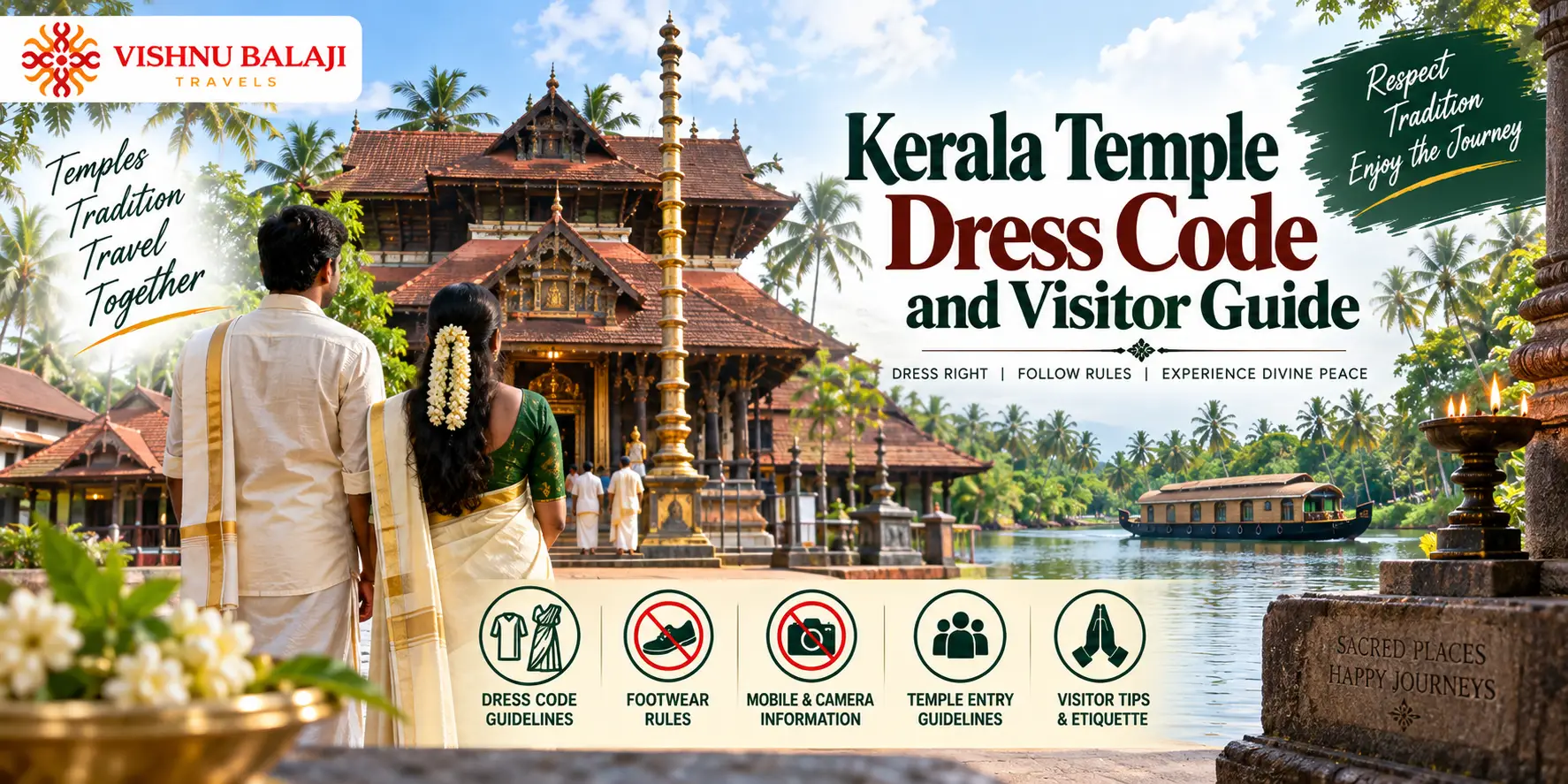
A temple visit in Kerala can feel quite different from visiting a regular sightseeing attraction. Traditional clothing is expected at many temples, footwear must be left outside, photography may be restricted, and entry practices can vary considerably from one shrine to another. Knowing these requirements before arriving can prevent last-minute problems at the entrance.
This Kerala Temple Dress Code and Visitor Guide from Vishnu Balaji Travels explains the practical clothing and entry guidelines travellers should know before visiting temples across Kerala. Since individual temple rules can change, visitors should also check the current instructions of the specific temple before their visit.
| Visitor | Commonly Accepted Traditional Wear | Better to Avoid |
|---|---|---|
| Men | Mundu / dhoti, traditional lower garment | Shorts and unsuitable casual wear |
| Women | Saree, set mundu, other permitted traditional attire | Shorts and clothing not permitted by the temple |
| Children | Modest, comfortable clothing as permitted | Very casual beach-style clothing |
Important: There is no single dress rule followed by every Kerala temple. Some temples have stricter requirements than others.
At traditional Kerala temples, men may be required or encouraged to wear a mundu or dhoti.
Before entering:
Some temples may provide or have nearby facilities where appropriate traditional clothing can be obtained.
Women should choose modest clothing suitable for the individual temple’s requirements.
Common choices include:
Rules regarding salwar kameez, churidar and other clothing can differ between temples. For this reason, visitors should not assume that an outfit accepted at one Kerala temple will automatically be accepted at another.
The Kerala Temple Dress Code is not a single statewide uniform. Each temple may follow its own traditions, customs and administrative regulations.
Differences can include:
When planning several temples on the same journey, check each temple individually.
Photography should never be assumed to be permitted simply because visitors can carry a phone into the outer premises.
Depending on the temple:
Look for the temple’s current instructions before taking photographs.
One of the most important rules for visiting temples in Kerala is to confirm entry eligibility before travelling.
Some Kerala temples have specific religious or customary entry restrictions. These policies are not identical across all temples.
Before visiting a particular shrine, check:
This is especially important for first-time visitors and travellers coming from outside Kerala.
For a comfortable temple visit, keep belongings simple.
Useful items can include:
Avoid carrying excessive luggage into temple areas. Large bags may need to be stored outside or at a designated counter.
Families travelling with children should check clothing and entry requirements beforehand rather than preparing only after reaching the temple.
Choose comfortable, modest clothing and carry an extra set when necessary. Parents should also keep children close in crowded queues and follow temple instructions regarding restricted areas.
A Kerala temple visitor guide should consider more than clothing rules when senior citizens are travelling.
Before the visit, check:
Planning darshan during a less crowded period can make the visit more manageable, although crowd levels can change during festivals and special days.
Temple regulations can become particularly important during festivals, special poojas and major pilgrimage periods.
Visitors may experience:
Allow extra time and check current temple information before departure.
A quick check can prevent unnecessary delays at the temple entrance:
This is particularly useful when visiting several temples in a single Kerala itinerary.
The most important point in this Kerala Temple Dress Code and Visitor Guide is that visitors should not treat every Kerala temple as having identical rules. Clothing accepted at one shrine, photography allowed in one complex or an entry procedure followed at one temple may be different at the next.
Vishnu Balaji Travels recommends checking the current Kerala Temple Dress Code and temple-specific instructions before beginning each visit. Understanding the rules for visiting temples in Kerala helps travellers arrive prepared and spend more of their time focused on darshan rather than dealing with avoidable entry issues.
The dress code varies by temple. Traditional and modest clothing is generally preferred, while some temples have specific requirements for men and women.
Men may be required to wear a mundu or dhoti at traditional temples. Some temples also have rules regarding shirts and other upper garments.
Women commonly wear sarees, set mundu or other traditional attire permitted by the temple. Accepted clothing can differ between temples.
It depends on the temple. Some temples permit them in certain areas, while others require traditional clothing for entry.
Rules vary. Some temples permit salwar kameez or churidar, while others follow stricter traditional dress requirements.
Mobile-phone rules differ by temple. Phones may be restricted or prohibited in certain temple areas, so check the current rules before entering.
Photography and videography may be restricted, especially near sanctums and other sacred areas. Always follow the temple’s displayed instructions.
Footwear should be left at the designated area or counter. Larger bags and restricted belongings may also need to be deposited outside.
No. Entry eligibility, dress requirements, photography policies and access to specific areas can vary between individual temples.
Check the current dress code, opening timings, entry restrictions, mobile and camera rules, footwear facilities and any festival-day arrangements.
Explore Popular Blog Posts Across Categories

Planning a spiritual and scenic journey across South Tamil Nadu is one of the most memorable travel experiences for families,…

How to Plan a South India Temple Tour by Vishnu Balaji Travels Planning a temple journey across South India requires…
Bangalore Temples List & Timings – Famous Temples & Sacred Shrines Bangalore is home to a diverse collection of historic…

Hyderabad Temples List & Timings – Sacred Temples Across the City Hyderabad is known not only for its historic landmarks…

A long South India pilgrimage becomes easier when every destination leads naturally to the next instead of requiring repeated travel…

South India Temple Tour Route Map A South India temple journey becomes much easier to understand when the destinations are…

South India is one of the most spiritual regions in India, famous for its ancient temples, peaceful atmosphere, traditional culture,…

South India Temple Tour for Overseas Indians By Vishnu Balaji Travels A South India Temple Tour for Overseas Indians is…